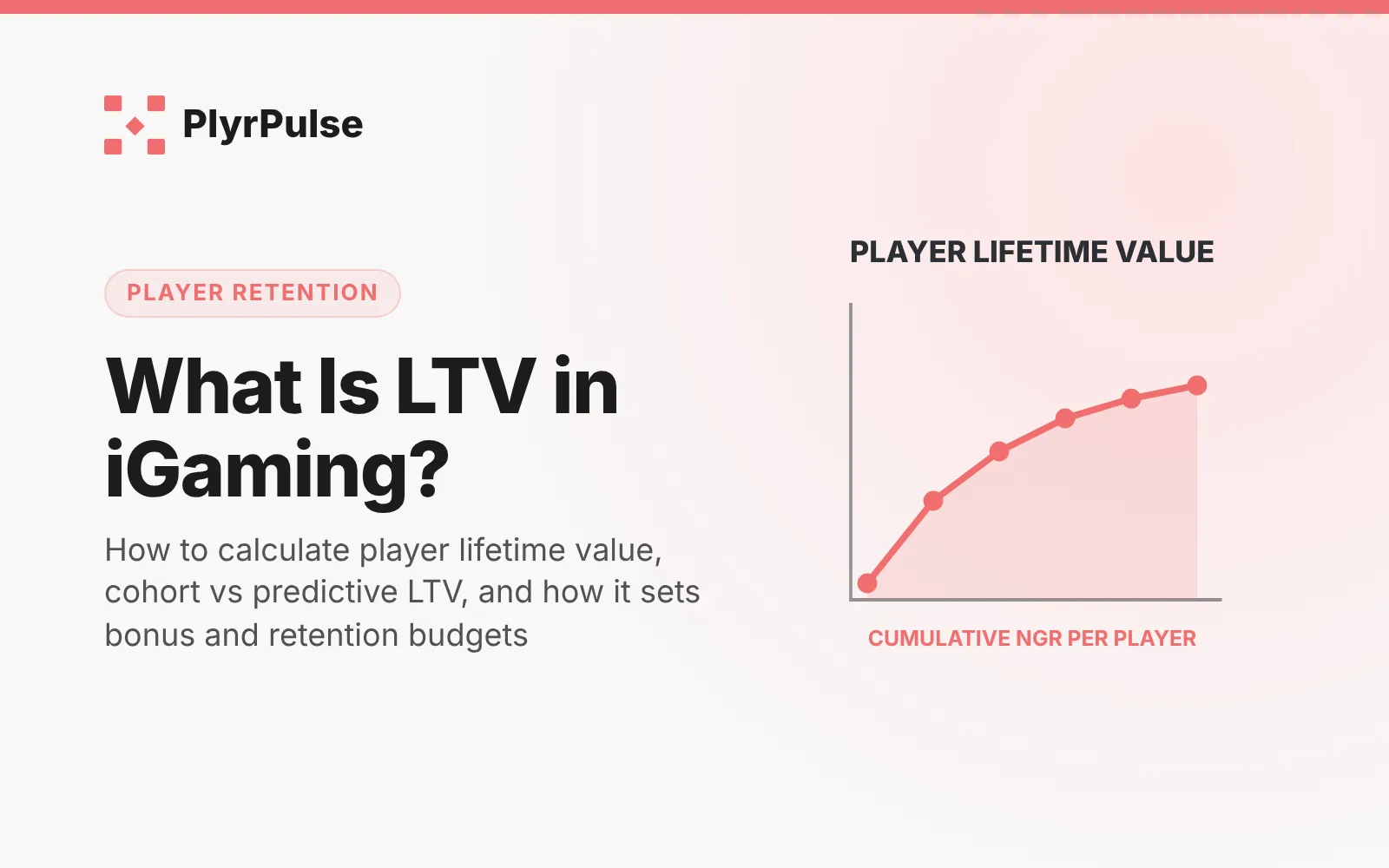
LTV (lifetime value) in iGaming is the net revenue a player is expected to generate for an operator across their whole relationship with the brand, usually measured as net gaming revenue after bonuses rather than deposits or GGR. Operators use it to decide how much they can afford to spend acquiring, rewarding and retaining each player.
That's the textbook answer. The useful answer is messier, because "LTV" in a casino or sportsbook dashboard can mean four different numbers depending on who built the report. One team counts deposits. Another uses GGR. A third subtracts bonuses but forgets gaming duty. And almost nobody writes down the time window.
This guide walks through what player lifetime value actually measures, how to calculate it with a simple worked example, the difference between cohort LTV and predictive LTV, and where the number should (and shouldn't) drive decisions on bonuses, VIP treatment and retention.
What Does LTV Mean for an iGaming Operator?
For an operator, LTV is the total value a player returns over a defined period after their first deposit, expressed per player. It answers one commercial question: what is a new depositor worth to us, after the cost of keeping them playing?
Three things separate a usable LTV figure from a vanity one:
- The value measure. Net gaming revenue (NGR) or contribution, not deposits or turnover.
- The time window. 90-day, 12-month or 24-month LTV are different numbers. Say which one.
- The group. LTV of all depositors, of one acquisition channel, or of one market. An average across everything hides almost everything.
If a report just says "LTV: 180", ask those three questions before anyone sets a budget from it.
How Is LTV Different From GGR and NGR?
GGR and NGR are period totals for the business. LTV is a per-player figure summed over time. They're related, but they answer different questions.
| Metric | What it measures | Typical use |
|---|---|---|
| GGR (gross gaming revenue) | Stakes minus winnings paid out, over a period | Headline revenue, tax base in many markets |
| NGR (net gaming revenue) | GGR minus bonus cost, and often minus taxes and fees, depending on the operator's definition | Affiliate revenue share, internal profitability |
| LTV (lifetime value) | NGR or contribution generated by one player (or the average player in a group) over a set window | Acquisition limits, bonus budgets, VIP and retention priorities |
The definition of NGR isn't standard across the industry. Some operators deduct only bonuses; others also take off gaming tax, payment fees and game provider royalties. Whatever your finance team uses, LTV should be built on the same base, otherwise the CRM team and finance end up arguing about two numbers that were never comparable.
My strong preference is to build LTV on contribution: NGR minus the costs that grow with play, such as gaming duty, provider fees and payment processing. It's the number that tells you what you can actually spend on a player.
How Do You Calculate LTV in iGaming?
The quickest version multiplies average monthly NGR per active player by the expected number of months a player stays active. Expected lifetime is often approximated as 1 divided by the monthly churn rate.
Simple LTV = average monthly NGR per active player × (1 ÷ monthly churn rate)
Then, to get to something you can budget against:
Contribution LTV = simple LTV × (1 − variable cost share)
A Worked Example (Hypothetical Numbers)
The figures below are made up to show the arithmetic. They are not benchmarks.
Say a casino brand looks at players who made their first deposit in March:
- Average NGR per active player per month: €40.
- Monthly player churn rate for this group: 20%.
- Expected lifetime: 1 ÷ 0.20 = 5 months.
- Simple LTV: €40 × 5 = €200.
- In this example market, gaming duty, provider fees and payment costs take 40% of NGR. Contribution LTV: €200 × 0.6 = €120.
Now put that next to acquisition. If this channel costs €150 per first-time depositor, the brand loses around €30 on each one. On the €200 "simple" figure it looked comfortably profitable. That gap is why the cost layer matters.
Where the Simple Formula Breaks
The 1 ÷ churn shortcut assumes players leave at the same rate every month. They don't. A big share of new depositors drop off in the first days and weeks (the reasons are covered in why new iGaming players leave in the first 7 days), and the ones who stay past the first couple of months tend to stick around longer. Constant-churn maths usually overstates early value and understates the tail.
So the formula is fine for a back-of-envelope check. For decisions, use cohort curves.
What Is Cohort LTV?
Cohort LTV tracks a group of players who started in the same period and adds up the actual NGR they produce, month by month, divided by the number of players who started. It's historical and it's honest, because it includes everyone who left.
Here's how a hypothetical March cohort of 1,000 first-time depositors might look:
| Months since first deposit | Cumulative NGR per depositor (hypothetical) |
|---|---|
| Month 1 | €45 |
| Month 3 | €85 |
| Month 6 | €120 |
| Month 12 | €155 |
The curve flattens. Most of the value arrives early, and each later month adds less. Two practical habits help when reading these:
- Compare like with like. A sportsbook cohort that started just before a major football tournament will look nothing like one that started in a quiet summer month. Line cohorts up by season, product and channel.
- Use the median as well as the mean. A handful of high-value players can drag an average up so far that it describes nobody. If the mean is three times the median, segment before you use it.
The catch with cohort LTV is time. You only know a 12-month figure after 12 months. That's too slow for deciding what to do with a player who deposited last Tuesday.
What Is Predictive LTV?
Predictive LTV estimates a player's future value from what they've done so far, usually in their first days or weeks, by comparing them with past players whose full value is already known. It turns "this player deposited three times in week one" into "players like this have typically produced X in their first year".
Inputs that usually carry signal include:
- deposit count and the gap between deposits in the first 7 to 30 days;
- stake size and how it changes, not just the first deposit amount;
- product mix, for example casino only, sports only or both;
- how much early play ran on bonus funds rather than real money;
- verification status, payment method and acquisition channel.
It works much like a predictive churn model, and the two belong together. Churn probability tells you who might leave. Predicted LTV tells you what you'd lose if they did. Multiply them and you get value at risk, which is a far better way to rank a retention list than either score on its own.
One honest warning. Early predictions are noisy, especially for casino players whose actual results swing with variance. Many teams use theoretical win (stakes multiplied by the game's house edge) instead of actual win as the value input, so a lucky or unlucky first week doesn't distort the forecast. For sportsbooks, expected margin on stakes does the same job.
How Does LTV Drive Bonus, VIP and Retention Decisions?
LTV earns its keep when it sets limits. Used well, it tells each team how much it can spend on a player without losing money, and where extra attention changes the outcome.
Acquisition Limits
The most common use. Compare contribution LTV by channel with cost per first-time depositor. If a channel's 12-month contribution is below what you pay to acquire, it's subsidised by the rest of the business, which is fine as long as someone decided that on purpose.
Bonus Budgets
A sensible rule is to cap a player's ongoing bonus spend at a share of their predicted contribution. Without a cap, the players claiming the most offers can end up with negative value. Watch for players whose activity only shows up when there's a promotion live; that pattern overlaps with bonus abuse, and those accounts can look valuable on turnover while producing little or no NGR.
VIP Treatment
Predicted LTV helps spot potential VIPs early instead of waiting six months for the data. But it must never be the only gate. Rapidly rising deposits can look like "high value" to a model and also be a sign of harm. Any VIP shortlist should pass through markers of harm and affordability checks first.
Retention Priorities
Rank by value at risk, then match the action to the reason the player is drifting. Sometimes that's an offer. Often it's fixing a slow withdrawal or a broken payment method, which costs less and keeps more.
What Responsible Gambling Limits Apply to LTV?
LTV should never be a reason to contact or reward a player who has self-excluded, taken a break, opted out of marketing or shows indicators of harm. The protection check runs first; the value ranking runs on whoever's left.
A couple of rules worth building into the system rather than leaving to campaign managers:
- Treat players who left for safer gambling reasons as a protected exit, not as lost lifetime value to win back.
- Don't let high predicted LTV override a harm flag, ever. If anything, high value with rising risk signals should trigger a review, not a VIP call.
There's also a measurement point here. If your LTV model learns from history that includes harmful play, it will rate similar behaviour as valuable. Review which features push predictions up, and keep harm indicators out of the positive side of the model. See how responsible gaming compliance sits next to retention in PlyrPulse.
What Are the Most Common LTV Mistakes?
I'd check for these before trusting any LTV report:
- Using deposits as value. Deposits include money that goes straight back out as withdrawals. They overstate value, sometimes badly.
- Using GGR and ignoring bonus cost. A player who wins back most of their bonus-funded play can look healthy on GGR and be a loss on NGR.
- No stated time window. "LTV" with no horizon can't be compared with anything.
- One average for everyone. Casino, sportsbook, market, channel and VIP tier all behave differently.
- Actual win in short windows. Variance makes early actual results unreliable. Use theoretical win or expected margin for predictions.
- Leaving protected exits in the history. Self-excluded players then look like churned value you should recover. They're not.
Where Does PlyrPulse Fit?
PlyrPulse is an iGaming CRM built on live player data, so lifetime value, churn risk, bonus-abuse flags and responsible gambling indicators sit on one player profile. That's what lets a value-based list check itself against protection flags before anyone sends an offer.
See how player retention with lifetime value and churn insight works in PlyrPulse. LTV is only as good as the deposit, wagering and bonus events behind it, so clean integrations matter. If you're comparing tools, our guide to choosing iGaming CRM software covers what to look for, and you can book a PlyrPulse demo to try LTV scoring on your own data.
Frequently Asked Questions About LTV in iGaming
What is LTV in iGaming?
LTV, or player lifetime value, is the net revenue a player is expected to generate for an operator over a defined period, usually measured as NGR or contribution after bonuses and variable costs. It is used to set acquisition, bonus, VIP and retention budgets.
How do you calculate player LTV for a casino?
A quick estimate is average monthly NGR per active player multiplied by expected lifetime in months, often taken as 1 divided by the monthly churn rate. For decisions, track cohort LTV, which sums the actual NGR of players who started in the same month, and subtract variable costs to reach contribution.
What is the difference between LTV and NGR?
NGR is a revenue total for a period, usually GGR minus bonus cost and sometimes taxes and fees. LTV is the NGR or contribution one player, or the average player in a group, produces over their time with the brand.
What is predictive LTV?
Predictive LTV estimates a player's future value from their early behaviour, such as deposit frequency, stake trend and product mix, by comparing them with past players whose full value is known. It lets operators act in the first weeks instead of waiting months for cohort data.
Should high-LTV players always get VIP treatment?
No. High predicted value can overlap with signs of gambling harm, such as rapidly rising deposits. Players should pass responsible gambling and affordability checks before any VIP offer, and anyone who has self-excluded or opted out should never be contacted.
Conclusion: Treat LTV as a Spending Limit, Not a Score
LTV in iGaming is most useful when it's specific: built on NGR or contribution, tied to a stated time window, split by product and channel, and checked against protection flags before it touches a campaign. Get those basics right and it tells you how much a player is worth spending on, and how much you'd lose if they drifted away. If you want lifetime value, churn risk and safer gambling signals on one player profile, see how PlyrPulse player insight works.