An iGaming CRM is a customer relationship management system built for online casinos and sportsbooks. It collects each player's deposits, bets, sessions and bonus history into one profile, groups players into segments, and triggers retention campaigns or risk reviews based on what each player actually does.
That's the textbook version. The one I'd give a new hire is shorter: the CRM decides what happens to a player after sign-up. Which message, which offer, which channel, and, more often than marketing likes to admit, whether that offer is allowed for that player at all.
I've come at this from data analysis at Aristocrat Interactive, sportsbook and PAM technology at OpenBet, and risk analytics at GiG in Malta. So yes, I'll cover how it works, features and KPIs. But I'll also spend time on the part most CRM articles skip: the risk side of the same player data.
How Does an iGaming CRM Work?
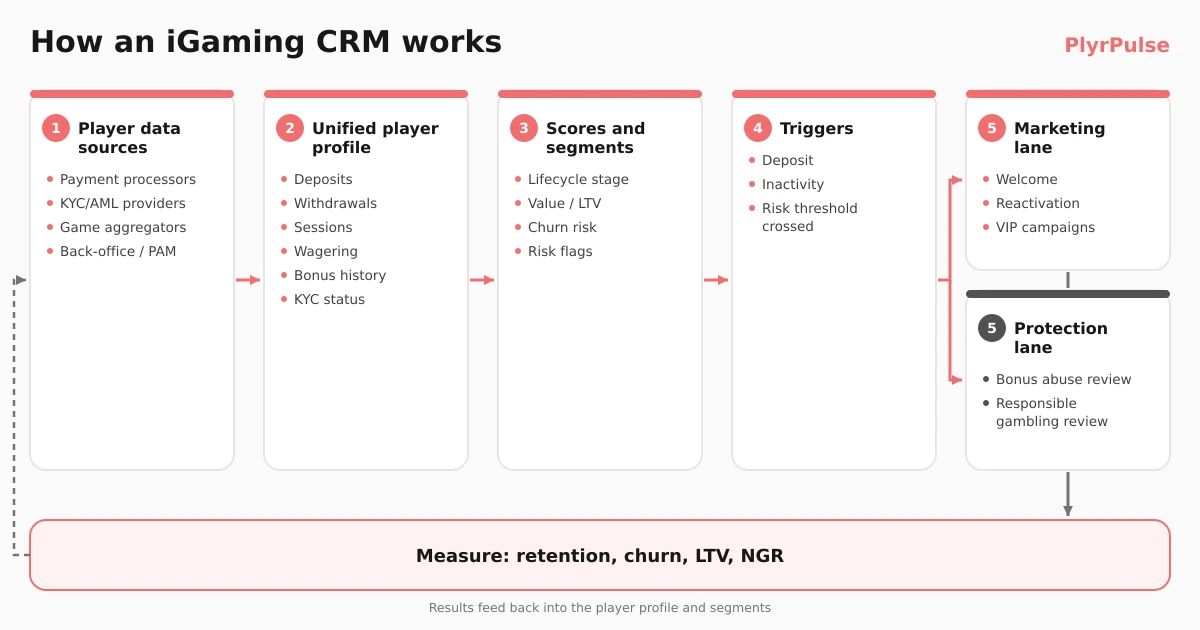
An iGaming CRM runs a loop: data comes in, players get sorted into segments, triggers fire, and campaigns or reviews go out.
In practice, the data arrives from four places: the payment processor, the KYC/AML provider, the game aggregators, and the operator's back-office or player account management (PAM) platform. Segmentation groups players by lifecycle stage, value, game preference, activity and risk. A trigger is a rule with a condition attached: a first deposit, seven quiet days, a sudden jump in stake size. The action might be a message, an offer, or a ticket for a human.
Data: The Unified Player Profile
Everything downstream reads from the player profile, so if it's thin, the rest of the system is guessing. A decent iGaming profile holds registration details, deposit and withdrawal history, session length and frequency, which games and verticals someone plays, bonus history, payment methods, KYC status and responsible gambling flags.
Bet-level events are the tricky part. One busy Saturday on a sportsbook can out-produce a B2B customer's whole quarter, and in my PAM integration days, volume was usually the first thing to break a general CRM.
Segments: Grouping Players by Behavior
Segments are groups of players who behave alike or are worth roughly the same to the business. Think new depositors, steady regulars, VIPs, decliners, dormant accounts and risk-review cases. Recency, frequency and monetary value (RFM) looks backward at what a player has already done. Predictive scores, like churn risk or expected lifetime value, try to look forward. You want both. RFM on its own tells you someone has gone quiet after they've already left.
Triggers and Campaigns: Acting at the Right Moment
A trigger links a segment to an action. Someone registers and the welcome series starts. A regular goes silent for a week and a reactivation message goes out. A VIP's activity drops and their manager gets an alert, often worth more than any automated email.
Campaigns go out over email, SMS, push and on-site messages. The good teams measure each one against a holdout group that received nothing. Skip that and you'll credit the campaign with deposits that would've happened anyway.
What Are the Core Features of an iGaming CRM?
The core features are the ones that turn raw player data into a decision someone can act on. Every serious platform has segmentation that updates as behavior changes (not overnight), lifecycle automation for welcome, first-deposit, VIP and reactivation journeys, and a connection to the bonus engine so campaigns can hand out offers or hold them back. Messages need to reach players through email, SMS, push and on-site channels.
On top sits analytics (lifetime value, or LTV, and churn risk per player) and, increasingly, a risk layer that flags bonus abuse, fraud and signs of gambling harm. None of it works without payment, KYC/AML and game data integrations, plus Slack alerts and webhooks.
PlyrPulse sits mostly in that analytics and risk layer. Its player behavior analytics features cover real-time risk scoring, behavioral fingerprinting, and LTV and churn risk for every player, and CRM managers can build CLV and lifecycle segments on top.
iGaming CRM vs General CRM: What Is the Difference?
An iGaming CRM is different from a general CRM in three ways: the data it holds, the events that trigger it, and the compliance rules it has to apply. A general CRM tracks contacts, deals and support tickets in a sales pipeline. An iGaming CRM tracks real-money play and has to respect licence conditions player by player.
| Attribute | General CRM | iGaming CRM |
|---|---|---|
| Core record | Contact or account | Player with wallet, wagering and bonus history |
| Event volume | A few interactions per week or quarter | Many events per session (bets, spins, deposits) |
| Main triggers | Form fills, email opens, deal stages | Deposits, withdrawals, inactivity, stake changes, risk scores |
| Segmentation | Demographics, firmographics, purchase history | Lifecycle stage, value, game preference, churn and risk |
| Key integrations | Email, sales and support tools | PAM, payment processors, KYC/AML providers, game aggregators |
| Compliance scope | Data protection and marketing consent | Data protection plus gambling licence rules: self-exclusion, bonus terms, player protection, AML |
| Risk detection | Not a core function | Bonus abuse, multi-accounting and markers of harm |
The bottom two rows matter most. You can stretch a general CRM to fit, but you'll end up building the bet-level data handling and responsible gambling logic yourself. That's most of the hard work.
Beyond Marketing: What Else Does an iGaming CRM Do?
An iGaming CRM also protects the operator and the player, because the deposits, bets and withdrawals behind a reactivation campaign are the same data that shows bonus abuse and gambling harm. Most guides treat these as separate products. From the risk desk, that never made sense: one player, one history, one profile.
Player Behavior Analytics
Player behavior analytics means studying how each player bets, deposits, withdraws and plays over time to understand both their value and their risk. A campaign tool can tell you a player's activity dropped. Behavior analytics should tell you why.
In risk work, the flags that got acted on were the ones an analyst could explain to someone else in a sentence or two. A score with no reason attached usually sat in the queue. PlyrPulse explains each signal in plain language, so a CRM manager can see what changed, and why it matters, before deciding what to do.
Bonus Abuse Detection
Bonus abuse is when players exploit casino or sportsbook promotions in ways the operator's terms don't allow. The classic version is multi-accounting, sometimes called gnoming, where one person or a group runs several accounts to claim the same welcome offer over and over. Bonus cycling is quicker: register, claim, clear the minimum wagering, withdraw within days, move on. Wagering circumvention uses low-risk or opposite-outcome bets, often across linked accounts, to clear wagering without any real play. Referral and promo abuse uses fake or linked accounts to collect rewards meant for genuine new players.
Bonus hunting is a grey area. Shopping between brands for the best offer isn't necessarily against the rules, and treating it as fraud annoys legitimate customers.
Why is this a CRM problem? The CRM hands out the offers, and every bonus an abuser takes is pure cost. In Great Britain, the Gambling Commission has capped bonus wagering requirements at 10 times since 19 January 2026 (UK Gambling Commission). If you want the mechanics, here's how bonus abuse detection flags multi-accounting and bonus cycling using behavioral fingerprinting and real-time risk scoring.
Responsible Gaming and Compliance
Responsible gaming inside a CRM comes down to two jobs: spotting players who may be at risk of harm, and making sure marketing doesn't make things worse for them. EN 18144:2025, a voluntary European standard published by CEN, sets nine markers of harm as the minimum to analyse. They are volume of stakes, speed of play, depositing behaviour, cancelled withdrawals, player-initiated contact, gambling time, gambling products, use of responsible gambling tools, and losses.
Here's the conflict: climbing deposits and cancelled withdrawals are just what an aggressive retention flow might reward. In Great Britain, licence conditions require operators to monitor customer activity from account opening and to stop new bonus offers for customers showing strong indicators of harm (UKGC LCCP). A CRM blind to RG flags will eventually send a reload bonus to exactly the wrong person.
PlyrPulse's responsible gaming compliance tools flag markers of harm and produce audit-ready reports. Flags are signals for review, not diagnoses, and the decision about any intervention stays with the operator's team and policies. That's the right design, in my view.
Which KPIs Does an iGaming CRM Track?
An iGaming CRM tracks whether players stay, how much they're worth, and what it costs to keep them. Five numbers do most of the work:
| KPI | What it measures | Why it matters to CRM |
|---|---|---|
| Retention rate | Share of a player cohort still active after a set period (for example day 7 or day 30) | Shows whether onboarding and lifecycle journeys work |
| Churn rate | Share of players who stop playing in a period | Signals where reactivation or service must improve |
| Lifetime value (LTV) | Revenue a player is expected to generate over their relationship with the brand | Sets how much the operator can spend on bonuses and VIP care |
| Net gaming revenue (NGR) | Gross gaming revenue minus bonuses and other deductions such as gaming taxes (exact definition varies by operator) | Shows real revenue after incentive cost |
| Reactivation rate | Share of dormant players who return and play again | Measures win-back campaigns |
Two habits make these numbers honest. Measure campaign impact as incremental NGR against a holdout, not as gross deposits. And put bonus cost next to your abuse flags. Bonuses taken by abusers pull NGR down without lifting LTV. Easy to miss when the figures live in different teams' dashboards.
How Do You Choose an iGaming CRM?
Choose an iGaming CRM by checking how well its data, risk and compliance coverage fits your brands and the markets you're licensed in. Start with integrations. If it can't connect cleanly to your payment processors, KYC/AML providers, game aggregators and back-office, nothing else on the feature list matters. After that, my shortlist:
- Segments that update in real time, not in a nightly batch.
- LTV, churn risk and lifecycle segmentation for each player.
- Detection of multi-accounting, bonus cycling and markers of harm.
- Flags that explain the behavior behind them, so analysts can clear edge cases instead of blocking genuine players.
- Risk and VIP thresholds your own team can set.
- Multi-brand and multi-jurisdiction support. A rule that's fine in one licence can be a breach in another.
- Slack alerts, webhooks and API access, so a review starts where your team already works.
If you are comparing platforms in more depth, I have a separate buyer's guide to the best iGaming CRM software, including an evaluation checklist, demo questions and a switch plan that does not drop suppression lists.
Plenty of vendors only quote on request. PlyrPulse publishes its iGaming CRM pricing plans. There's a free Starter plan for one brand, a Pro plan with full behavioral scoring, unlimited brands and real-time risk flagging, and a custom Enterprise plan with multi-jurisdiction compliance tools and custom API access.
Frequently Asked Questions About iGaming CRM
What does CRM mean in iGaming?
CRM in iGaming means customer relationship management for online casino and sportsbook players. It covers both the software that holds each player's profile and the day-to-day practice of using it to segment players, run lifecycle campaigns and apply each market's rules.
Is a casino CRM different from a sportsbook CRM?
They usually run on the same core platform but read different data. A casino CRM looks at game and provider preferences, spins and session patterns. A sportsbook CRM looks at bets, markets, stakes and the fixture calendar.
What is the difference between a CRM and a CDP in iGaming?
A customer data platform (CDP) pulls player data from every source into one profile. A CRM uses that profile to decide on an action and deliver it. Many iGaming CRMs now do their own data unification, so the line is blurrier than it used to be.
Can an iGaming CRM detect bonus abuse?
Yes, if it includes risk scoring. It looks for linked accounts, fast deposit-to-withdrawal patterns, low-variance wagering, and bursts of registrations right after a promotion goes live.
How does an iGaming CRM support responsible gambling?
It flags markers of harm, such as rising deposits or cancelled withdrawals, and stops marketing to players who are at risk or self-excluded. The operator's team reviews each flag and decides on any intervention.
Does an iGaming CRM make an operator compliant?
No. A CRM can monitor behavior, flag issues and keep records, but it doesn't make anyone compliant on its own. The operator's policies, licence conditions and team judgment still decide what happens next.
How much does an iGaming CRM cost?
It varies a lot, and many vendors only quote on request. PlyrPulse offers a free Starter plan, a Pro plan at $21 per month billed annually ($25 billed monthly), and custom Enterprise pricing.
Conclusion: iGaming CRM Connects Retention and Risk
An iGaming CRM turns each player's data into the next sensible action. Sometimes that's a reactivation offer. Sometimes it's a bonus abuse review, and sometimes it's a responsible gambling check that means no offer at all. Operators who run retention and risk from the same player profile end up making offers that are both profitable and permitted. If you'd like to see that on live player data, take a look at PlyrPulse player intelligence features.