The best iGaming CRM software is the platform whose data model, triggers and compliance controls match how your players behave and where you are licensed. There is no single best product for every operator. The right choice depends on whether your biggest leak is churn, bonus cost or a gap in responsible-gaming controls, and on how many brands and licences you run.
That's the short answer. The rest of this guide is the method: the attributes that separate iGaming CRM platforms, the features worth testing, a practical checklist, the questions to ask in a demo, and how to switch without losing player data. I write for PlyrPulse, so the section on where it fits is clearly marked, and its limits are in plain view.
If you still need the category defined, start with what an iGaming CRM is and how it works, then come back.
What Is iGaming CRM Software?
iGaming CRM software is a customer relationship management system built for online casinos and sportsbooks. It collects deposits, bets, sessions and bonus history into one player profile, groups players into segments, and triggers a campaign or a risk review from what each player actually does.
A general CRM is usually not enough. Bet-level event volume, wallet and bonus data, and gambling-licence rules are not standard objects in a sales CRM, so you would end up building those parts yourself. The longer definition, and how the data loop works, is in the iGaming CRM explainer.
What Makes the Best iGaming CRM Software?
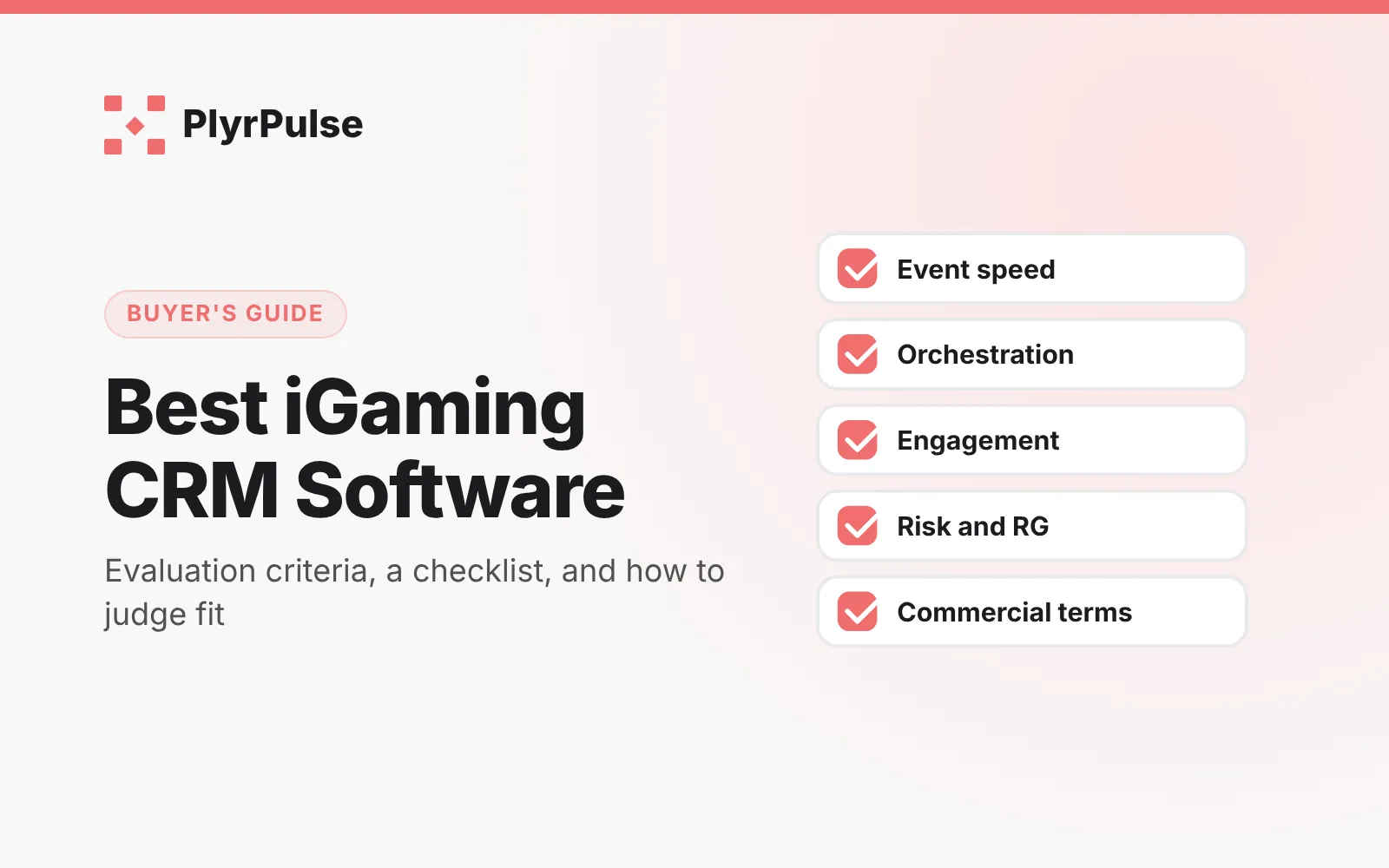
The best iGaming CRM software is the one that fits five attributes, not the one with the longest feature list. Feature pages start to look alike after a while. These are the attributes I use to tell platforms apart:
- Event speed. How fast a bet, deposit or withdrawal reaches the player profile and can fire a trigger. Real-time and nightly batch are different products.
- Orchestration depth. Journeys, channels, frequency caps, control groups and uplift testing.
- Engagement mechanics. Bonus engine, missions, tournaments, jackpots and on-site rewards.
- Risk and compliance coverage. Bonus abuse detection, markers of harm, self-exclusion suppression, consent and an audit trail.
- Commercial clarity. Whether pricing is published, and what implementation asks of your own team.
Most platforms are strong on two or three of these. Very few are strong on all five, and the ones that come close usually price for operators who can absorb a longer sales and onboarding cycle.
iGaming CRM Features That Separate Platforms
iGaming CRM features are only useful if they change what happens to a player in time. When you compare platforms, test the features below against live or sample event data, not against a slide.
Event ingestion and the player profile
The profile has to hold registration details, payments, session and bet history, bonus claims, KYC status and responsible-gambling flags. Ask how quickly a bet or a failed deposit is available to a segment or a journey. If the profile updates overnight, same-session offers and same-session blocks are not possible.
Segmentation and orchestration
Look for segments that can update as events arrive, plus journeys across email, push, SMS and on-site channels. Control groups and incrementality measurement matter if you spend serious money on bonuses. A journey that cannot suppress a self-excluded or flagged player is not ready for a regulated market.
Engagement and gamification
Missions, tournaments and bonus engines can lift retention, but every reward is also a payout path. Ask whether risk and responsible-gaming flags can block eligibility before a mission or a bonus is granted, not after it has been paid.
Risk, bonus abuse and responsible gaming
Some platforms detect bonus abuse themselves. Others accept a flag from your own systems and use it only to suppress marketing. Both models can work, as long as you know which one you are buying. For responsible gambling, the useful features are markers of harm, suppression of marketing to self-excluded or at-risk players, and records of who reviewed a flag and what they decided.
Player churn, bonus abuse and markers of harm are separate problems that share the same player data. A CRM that keeps those signals on different profiles makes it easy to send the wrong offer.
Integrations and delivery
Without a clean connection to your PAM, payments, KYC and game aggregators, none of the features above work. Ask which of those systems are supported out of the box, how events are mapped, and how flags can leave the CRM (webhooks, Slack, API) so another tool can act on them.
Casino CRM Software and Sportsbook CRM: What Changes
Casino CRM software and sportsbook CRM usually share a core platform, but they read different events. A casino CRM leans on game and provider preference, spins, session length and bonus cost. A sportsbook CRM leans on markets, stakes, bet type and the fixture calendar, and often needs triggers that can react to a live event.
If you run both verticals, ask whether one player profile can hold both sets of events, and whether a responsible-gaming or abuse flag set in one vertical also suppresses offers in the other. Multi-brand and multi-jurisdiction operators should also check that a rule which is fine under one licence can be blocked under another.
How Do You Choose an iGaming CRM Platform?
Choose an iGaming CRM platform by starting with your most expensive problem, then checking integrations and compliance before you fall in love with features. My order of questions:
- Where are you losing money? If it is churn, weight orchestration, personalisation and failed-deposit recovery. If it is bonus cost, weight abuse detection and eligibility controls. If it is regulatory exposure, weight markers of harm, suppression and audit trails.
- Does it connect to your PAM, payments, KYC and game aggregators? Without clean data, nothing else on this list works.
- Can it stop an offer, not just send one? Ask the vendor to show a self-excluded player and a flagged bonus abuser being suppressed from a live campaign, end to end.
- Can an analyst explain every flag? In my risk work, unexplained scores tended to sit in the queue. Explained ones got actioned.
- What does implementation ask of you? Who maps events, who builds the first journeys, and how long until a real campaign or a real review goes out.
- Is pricing published, and what is in each plan? A public price is not a quality signal on its own, but it tells you whether you can assess fit before a sales process.
One pattern I would question: buying the biggest engagement suite first and adding risk "later." Later usually arrives after a promotion has already been farmed.
iGaming CRM Evaluation Checklist
Use this checklist in a demo or a proof of concept. Score each item against your own licences and data, not against a generic feature matrix.
| Check | What "good" looks like |
|---|---|
| Event speed | Bets, deposits and withdrawals update the profile in time to trigger or block an action in the same session, if you need that |
| Player profile | Payments, bets, bonuses, KYC and RG flags sit on one profile, including across brands and verticals you actually run |
| Orchestration | Journeys, frequency caps and control groups exist; a suppressed player cannot be reached by a parallel campaign |
| Risk and bonus abuse | You know whether detection is built in or imported, and a flag can block a bonus or a payout path, not only an email |
| Responsible gaming | Markers of harm, self-exclusion and cooling-off states suppress marketing automatically, with a review record |
| Consent and jurisdiction | Per-product or per-market consent, and licence rules, are enforced before a send |
| Integrations | PAM, payments, KYC and game data have a realistic path in; flags can leave via webhook, Slack or API |
| Implementation | Event mapping, first journeys and first reports have named owners and a realistic timeline |
| Commercial terms | Price, contract term, brand limits and what is not included are clear before you sign |
Questions to Ask Before You Buy iGaming CRM Software
These questions expose gaps that a feature list will not:
- How soon after a bet, deposit or withdrawal is that event available to a segment, a journey or a risk rule?
- Can you show a self-excluded player being blocked from every channel, including on-site and push, not only email?
- Who creates the bonus-abuser flag: your platform, or our own systems?
- If a player is flagged for harm or abuse in the casino, are they also suppressed in the sportsbook, and vice versa?
- How does an analyst see the reason behind a flag, and can they clear a false positive without a developer?
- What does a typical implementation look like for an operator with our number of brands and our PAM?
- Which of our current tools can you replace, and which should we keep and connect?
- Is pricing published? If not, what drives the quote: players, brands, channels, or modules?
How Do You Switch iGaming CRM Software Without Losing Data?
Switch iGaming CRM software by running the new platform in parallel before you cut over. A single switch date is how suppression lists and consent records get lost.
In practice:
- Export what you will need. Player attributes, segments, journey logic, consent records and suppression lists, including self-exclusions and at-risk states.
- Map events first. Deposits, bets, withdrawals, bonus claims and responsible-gaming events must arrive in the new tool with the same meaning they had in the old one.
- Rebuild suppression before campaigns. Self-excluded and at-risk players should be blocked in the new system before the first offer goes out.
- Run a shadow period. Compare segment sizes and risk flags between both platforms for a few weeks.
- Cut over one brand at a time. Keep the old journeys paused, not deleted, until the new ones prove out.
Step three is the one I would never skip. A migration is exactly when a reload bonus lands in the wrong inbox.
Where Does PlyrPulse Fit?
PlyrPulse is an iGaming CRM and back-office intelligence platform focused on the risk side of the player profile. Its player behavior analytics features cover real-time risk scoring, behavioral fingerprinting, automated KYC summaries, and lifetime-value and churn insight per player. Bonus abuse detection flags multi-accounting, bonus cycling and low-risk wagering, and the responsible gaming compliance tools flag the nine markers of harm from EN 18144 and produce audit-ready reports. Each flag comes with a plain-language reason.
Honest limits first. PlyrPulse is not a multichannel campaign sender, and it does not have a gamification suite. It does not replace an engagement platform that you use to send email, SMS or push campaigns. Flags reach your team and tools through Slack alerts, webhooks and, on Enterprise, a custom API, listed on the integrations page. Many operators would run it next to an engagement platform, not instead of one.
It suits risk, fraud and responsible-gaming teams who want explainable flags, and smaller operators who want to start without a sales cycle.
Pricing is published. Starter is free for one brand. Pro is $21 per month billed annually or $25 billed monthly. Enterprise is custom.
Frequently Asked Questions About iGaming CRM Software
What is the best iGaming CRM software?
There is no single best iGaming CRM software for every operator. The right platform is the one that fits your licences, your event sources and your main leak, whether that is churn, bonus cost or responsible-gaming control. Use the criteria and checklist in this guide, and treat a demo of suppression and flag handling as a requirement, not a nice-to-have.
What should I look for in iGaming CRM software?
Look first at event speed, the completeness of the player profile, orchestration, risk and responsible-gaming coverage, integrations and commercial terms. Features only matter if they can trigger or block an action on time, and if an analyst can explain the flags they produce.
Which iGaming CRM platforms publish their pricing?
Many iGaming CRM vendors only quote on request. PlyrPulse publishes its prices: a free Starter plan, Pro at $21 per month billed annually ($25 billed monthly), and custom Enterprise.
Do iGaming CRM platforms detect bonus abuse?
Some do, with their own detection. Others mainly accept a bonus-abuse flag from the operator's systems and use it to suppress offers. PlyrPulse has dedicated bonus abuse detection. Ask which model a vendor uses, and whether a flag can block a bonus or a payout, not only a message.
Can I use two CRM tools together?
Yes, and many operators do. A common setup pairs an engagement platform for campaigns with a separate risk tool, connected through webhooks or APIs so flags can block offers.
How does a CRM support responsible gambling?
It monitors behavior for markers of harm, suppresses marketing to self-excluded or at-risk players, and keeps records of decisions. The operator's team still decides any intervention under its own policies. Software does not make an operator compliant on its own.
Is a general CRM good enough for an online casino?
Usually not. General CRMs are not built for bet-level event volume, wallet and bonus data, or gambling licence rules, so you would end up building those parts yourself.
How long does it take to switch iGaming CRM software?
It varies with your data feeds, number of brands and journeys. A parallel run and a brand-by-brand cutover is safer than a single switch date.
Conclusion: Match the Platform to the Problem
The best iGaming CRM software is the one that solves your most expensive problem first, without opening a hole in compliance. Start with event speed, suppression and integrations, then judge orchestration and engagement. If bonus abuse and responsible gaming are where you need clarity, compare PlyrPulse plans and try the free Starter plan on one brand.