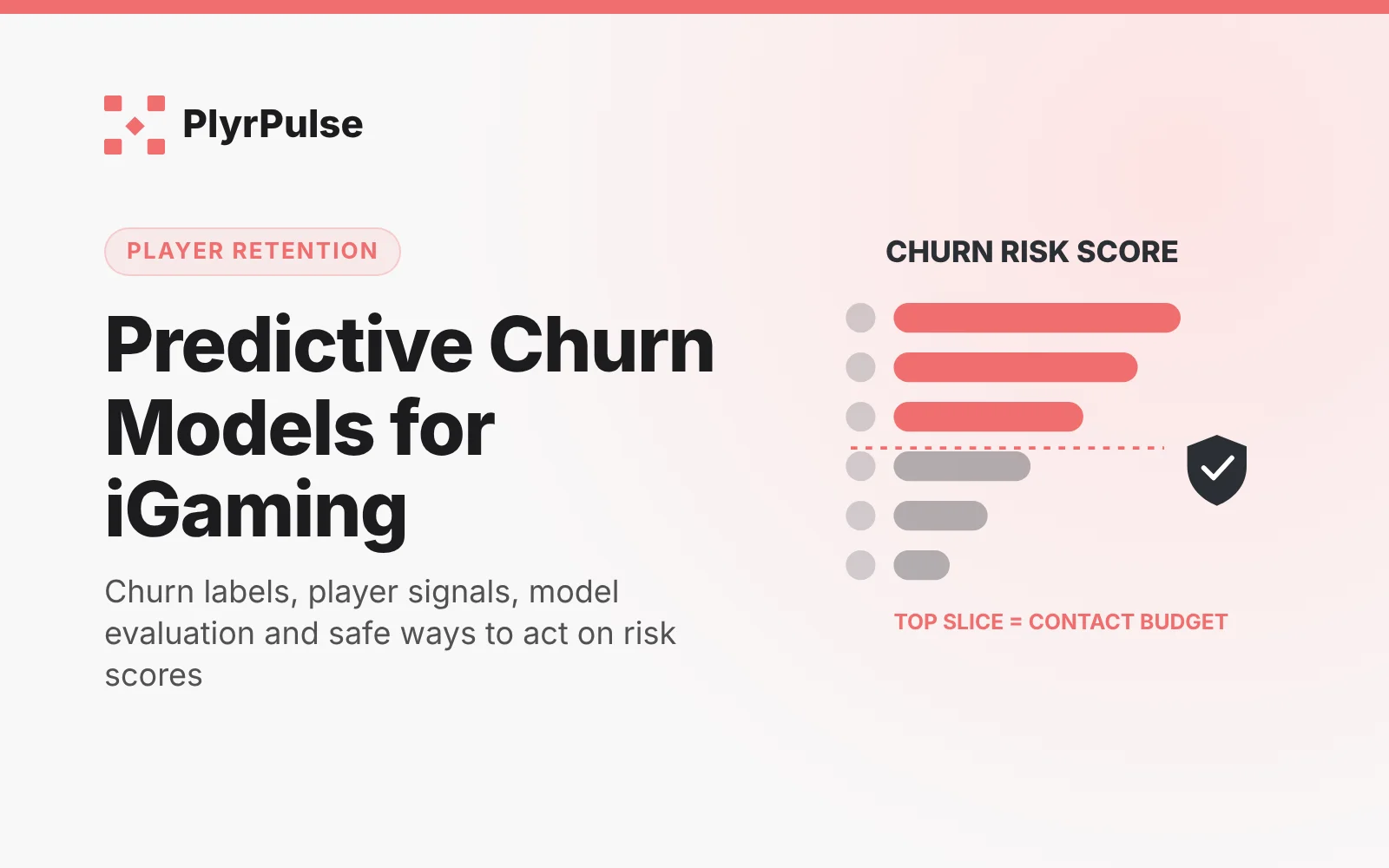
A predictive churn model for iGaming estimates how likely each active player is to stop playing within a set window, using recent behaviour such as session recency, deposit cadence and bonus dependence. Its job is to rank players so a CRM team can spend a limited retention budget where it changes outcomes, while players showing signs of harm are kept out of promotional contact.
Your player churn rate tells you how many active players you lost last month. It doesn't tell you who is about to leave next month, which is the question a retention team can actually work with. A churn model answers it one player at a time.
This guide covers the decisions that make or break one: the churn label for casino and sportsbook, the features that carry signal, model types, evaluation, and acting on scores without pushing promotions at people who should be protected.
What Is a Predictive Churn Model in iGaming?
A predictive churn model is a scoring system that gives each eligible player a probability of meeting your churn definition within a future window, for example "no real-money activity in the next 30 days". It looks at what the player did in a recent observation window and compares that pattern with players who did or did not leave in the past.
Three parts always need to be explicit:
- The population: which players get scored. Usually active, verified, marketable accounts.
- The label: what counts as churn, and over what window.
- The action: what the CRM team will do with a high score, and for how many players.
If any of the three is vague, the model will be hard to use however accurate it looks. A well-tuned model is wasted if nobody agreed whether a sportsbook player who sits out the off-season counts as "churned". Settle the definitions first.
How Should You Define Churn Before You Model It?
You define churn by choosing an activity event, an inactivity window that fits the product, and a list of exits that do not count. The model can only learn the label you give it, so this choice matters more than the algorithm.
Casino and sportsbook players behave differently, and one window for both usually misleads:
| Product | Typical rhythm | Label that often fits | Watch out for |
|---|---|---|---|
| Online casino | Frequent, short sessions; deposit-led | No real-money wager or deposit in the next 30 days | Players who only played on bonus funds |
| Sportsbook | Tied to fixtures and seasons | No settled bet in the next 30 to 45 days, checked against the sports they follow | Off-season gaps that look like churn but are not |
| Mixed-product account | Moves between verticals | Inactive across all products, not just one | A player who moved from sports to casino is not lost |
| New players (first weeks) | No personal baseline yet | Milestone-based, such as no second session within seven days | Treat as onboarding, not as model churn |
Treat these as starting points to test against your own data, not as standards. Two more rules keep the label clean.
First, remove protective exits. A player who self-excludes, takes a time-out or closes the account for safer gambling reasons has not "churned" commercially. Leave those exits in the label and the model learns to predict them, so the CRM team ends up targeting the behaviour that came before a protection decision. Count them separately.
Second, decide whether you predict player churn or value churn. A high-value player who drops to a fraction of their usual deposits is still "active" under a simple label, so some operators run a second model for sharp drops in value.
New accounts have almost no history, so a model trained on established players scores them badly. Their early exits are usually onboarding problems, covered in why new iGaming players leave in the first 7 days. Use milestone triggers there, and bring players into the churn model once they have a few weeks of history.
Which Player Features Predict Churn in iGaming?
The features that predict churn are changes in a player's own behaviour: how recently they played, how their deposit and session rhythm is shifting, and how much of their activity depends on bonuses. Absolute levels matter less than trends against the player's own baseline.
Group features into families so the model, and the people reading it, can explain a score:
- Recency and session pattern: days since last session, days since last real-money bet, session count this week compared with the player's average, change in session length.
- Deposit cadence: days since last deposit, gap between deposits compared with the player's usual gap, deposit count trend, share of deposits that failed.
- Value trend: net gaming revenue or stake over the last weeks compared with the prior period, average stake trend, change in product mix.
- Bonus dependence: share of turnover played with bonus funds, how often the player only appears when an offer is live, bonus claims that end with no real-money play afterwards.
- Product and content: variety of games or sports played, and whether the player's favourite content is still available.
- Friction and service: withdrawal waiting time, verification requests, support contacts and complaints.
- Lifecycle context: tenure, acquisition channel, market, device.
A concrete example. Two casino players each deposited four times last month. One deposits every Friday and skipped this Friday. The other deposits at random and played yesterday. A snapshot of "deposits last 30 days" treats them as equal. A cadence feature ("days since last deposit divided by the player's usual gap") flags the first and leaves the second alone. Features built relative to the individual tend to carry the most signal.
Bonus dependence needs a careful reading. A player whose activity collapses whenever offers stop may be price-sensitive, or may be part of a pattern of bonus abuse. A retention offer for the first can make sense. For the second it only funds the abuse. Check those signals before any offer goes out, which is where bonus abuse detection belongs in the flow.
What About Responsible Gambling Markers?
Responsible gambling markers such as rapid deposit escalation, repeated failed deposits, night-time play spikes or loss chasing should be available to the system, but not as reasons to send a promotion. Use them as suppression rules that sit in front of every retention action. The Gambling Commission expects licensees to identify markers of harm and to act on them, and lists "preventing direct or targeted marketing" among the actions that may be needed (UK Gambling Commission, customer interaction guidance, Requirement 8).
Avoid Leakage
Leakage happens when a feature quietly contains the answer. Fields like "account status = dormant" or "last campaign = win-back" are set after the player has gone quiet, so the model looks sharp in testing and fails in practice. Build features only from data that existed at scoring time.
Which Model Types Work for Churn Prediction?
Logistic regression, gradient-boosted trees and survival models all work for iGaming churn prediction; the right choice depends on how much data you have, how much explanation you need and whether you care about "if" or "when" a player leaves. Start simple and only add complexity when it earns its place.
| Approach | What it gives you | Good fit when | Trade-off |
|---|---|---|---|
| Rules and thresholds | A flag, such as "no deposit in 14 days and sessions down" | You need something this week, or data is thin | No probability; hard to rank players |
| Logistic regression | A probability with readable weights | You need a transparent baseline that compliance and CRM can read | Misses interactions unless you build them in |
| Gradient-boosted trees | Usually sharper ranking on tabular player data | You have enough labelled history and want better ranking | Needs explanation tooling and probability calibration |
| Survival models | Risk of leaving over time, not just within one window | Timing matters, such as when to send a check-in | Harder to explain and maintain |
| Uplift models | Who is likely to respond to contact, not who is likely to leave | You already run holdout experiments | Needs clean experiment data to train on |
I would build in this order: rules to agree definitions and set a baseline, then logistic regression to check the model learns sensible patterns, then gradient boosting if it clearly ranks better on held-out months. Survival and uplift models come later, once you are collecting experiment data.
Whatever you choose, give each score reason codes: the two or three features that pushed it up. "Deposit gap much longer than usual; sessions down; withdrawal pending" tells a CRM manager what to do. A bare 0.82 does not.
How Do You Know if a Churn Model Is Any Good?
You know a churn model is good when it ranks players well in the slice you can actually contact, its probabilities match observed churn, and it holds up on later months it never saw. A single accuracy figure tells you very little.
Use these checks:
- Time-based validation: train on older months and test on a later month. Random splits mix past and future and flatter the model.
- Precision@k: of the top k players by score, where k is the number your team can contact, how many actually churned? This is the number that matters to a CRM team with a fixed budget.
- Lift by decile: split scored players into ten bands and compare the churn rate in each with the overall rate. A useful model shows a clear staircase, with most churners in the top bands.
- Calibration: when the model says 30%, roughly 30% of those players should churn. Calibration matters whenever you multiply a probability by player value to set priorities. Calibration curves and methods are well documented, for example in the scikit-learn guide to probability calibration.
- Stability and segments: check that scores hold across months, markets, products and tenure bands, and after changes such as a new payment provider.
ROC AUC is a fine summary, but your team acts on the top slice, so judge the model there.
How Do You Turn Churn Scores Into Retention Actions?
You turn churn scores into actions by fixing an intervention budget, ranking eligible players by risk and value, matching the action to the reason code, and always keeping a random holdout group so you can measure what the contact changed.
Start From the Budget, Not the Score
Decide first how many players the team can contact each week and what each action costs, from an email to a VIP manager's call. Then work down the ranked list until that budget runs out. A list of everyone above a 0.5 threshold is usually more than a team can handle, and long lists end in generic batch campaigns.
Match the Action to the Reason
High churn risk is not a message. The reason code is. A player whose withdrawal has been pending for days needs a status update, not free spins. A sportsbook player whose league just finished may respond to news about the next competition. Bonuses come last, after bonus abuse signals and contact preferences have been checked.
Keep a Holdout Group
Hold back a random share of eligible high-risk players from contact, large enough for a readable comparison at your volumes. Compare their later activity, value and safer gambling indicators with the contacted group. Without a holdout you can't tell whether a campaign saved players or reached people who were coming back anyway.
Holdouts also show that the highest-risk players are not always the ones who respond. Some will leave whatever you do, and that gap is where an uplift model later earns its keep. Score daily or weekly, depending on how fast your players' rhythm changes, and retrain after any big product, payment or regulatory change.
What Responsible Gambling Guardrails Does a Churn Model Need?
A churn model needs guardrails that stop it from pushing promotions to players who show signs of harm, have used safer gambling tools or have opted out of marketing. Retention and protection read some of the same data, so the order of checks has to be fixed in the system, not left to campaign managers.
Build these rules in:
- Suppress before you rank. Remove self-excluded, timed-out and opted-out players, and anyone with open harm indicators, before the list reaches the CRM team.
- Never use harm markers as positive targeting signals. Escalating deposits can correlate with high "value" in a model. That is exactly why they must act as a block, not a boost.
- Route, don't market. A high-risk player with harm indicators goes to a safer gambling review, not a win-back journey.
- Check every channel. Email, SMS, push and VIP calls should all read the same suppression list.
- Watch side effects. Track safer gambling indicators in every experiment. A campaign that lifts activity and harm flags together is not a success.
The Gambling Commission notes that operators with more active customers will need monitoring systems that mix automated and manual processes, and that licensees must act in a timely way once an issue is identified (UK Gambling Commission, customer interaction guidance, Requirement 4). A churn model should read the same flags and step aside when they appear. See how responsible gaming compliance works alongside retention in PlyrPulse.
Where Does PlyrPulse Fit?
PlyrPulse is an iGaming CRM built on live player data, so churn signals, lifecycle segments, bonus-abuse flags and responsible-gambling indicators sit on one player profile. That is what lets a retention list suppress itself when a protection flag appears.
See how player behavior analytics and churn insight work, and how PlyrPulse player retention turns churn scores into safe next steps. Churn features depend on clean deposit, session and withdrawal events from your integrations. To test churn scoring on your own data, book a PlyrPulse demo.
Frequently Asked Questions About Predictive Churn Models
What is a predictive churn model in iGaming?
It is a model that estimates the probability that each active player will meet your churn definition, such as no real-money activity in the next 30 days, based on their recent behaviour. Teams use the ranked scores to decide who to contact and how.
Which algorithm is best for iGaming churn prediction?
There is no single best algorithm. Logistic regression is a transparent baseline. Gradient-boosted trees often rank players better on tabular data. Survival models help when timing matters. Pick the simplest model that performs well on later months it has not seen.
How do you measure a churn model's accuracy?
Test it on a later time period, then check precision in the top slice your team can contact, lift by score decile and calibration. Overall accuracy is misleading because most players do not churn in any given window.
Should high churn-risk players always get a bonus?
No. Match the action to the reason behind the score, check bonus abuse signals and contact preferences, and never send offers to players who have self-excluded, opted out or show indicators of harm. Many at-risk players need a fix, such as a faster withdrawal, rather than an offer.
How is a churn model different from a responsible gambling model?
A churn model predicts commercial lapse to guide retention. A responsible gambling model looks for signs of harm to guide protection. They can share data, but the protection side must always be able to override the retention side.
Conclusion: Predict Churn, Then Let Protection Decide Who Gets Contacted
A churn model is worth building only if it changes what your team does on Monday morning: a clear label per product, features built on each player's own rhythm, a model judged on the slice you can contact, and holdouts that prove the contact worked. Above all, a fixed order: protection first, retention second. If you want churn scores, reason codes and safer gambling flags on one player profile, see how PlyrPulse churn insight works.